

Tired of repeating yourself or watching mistakes pile up?
If your team or business feel disorganized and inefficient, it’s time for a Policy and Procedure Manual. Grab hold of a Policy and Procedure Manual Template and create your systems faster.
Looking for a Free Policy and Procedure Manual Template?
If you’re not ready to buy a template, we’ve put together this guide to help you understand what a Policy and Procedure Manual should contain and how to create one for your business.
Use the information below as a starting point, see examples of what should be included, and work through the key sections you need for your own Policy and Procedure Manual.
Read the guide below to get started.

Want the Complete Policy and Procedure Manual Template?
If you’re looking for a ready-to-edit Policy and Procedure Manual Template rather than starting from scratch, you can purchase our complete Microsoft Word Policy and Procedure Manual Template below.
Policy and Procedure Manual Template + 77 Free Templates – USD $57

Or, if you’d like to see exactly what’s included first, read the full Policy and Procedure Manual Template sales page.
Table of Contents
Tired of Chaos Running Your Business? You need a Procedure Manual.
Procedure Manuals lay out clear, step-by-step processes for every task – ensuring consistency, quality, and compliance with your standards.
It’s the simplest, most cost-effective way to boost your team’s performance practically overnight.
With everyone on the same page, your business becomes easier to manage and ready to thrive.
Ready to take control?
Learn more about procedure manuals and how they can support and grow your business below.
Need to download a free sample?
Or want to build an easy policy and procedure manual using Microsoft Word? The options are endless.
What is a Procedure Manual?
A procedure manual is a structured document that outlines the step-by-step processes, responsibilities, and standards for how tasks should be performed within an organization.
Wikipedia Definition of a Procedure Manual
Wikipedia defines a procedure manual (business) as:
✅ Best Practice
Definition. A procedures manual or procedural manual typically gathers together a number of procedures used within an organization, or for a specific set of functions.
https://en.wikipedia.org/wiki/Procedure_(business)
What are the Key Benefits of having a Procedure Manual?
Consistency
- Standardizes processes so your team delivers quality results every time.
Simplified Training
- New hires get up to speed faster with clear, accessible instructions.
Reduced Workload
- Frees up your time by providing your team with a reliable reference that minimizes questions and mistakes.
Scalability
- Supports business growth by maintaining structure and quality across teams.
What is the Difference Between Procedure Manuals and all the Other Manuals?
Before we go into the detail of procedure manuals – have you considered all the different types of manuals that might be useful for your business?
You can see from the table below that there are a range of manuals required for any business. Each manual has a different purpose and covers different aspects of an organization.
| Operations Manual | Procedure Manual | Policy Manual |
| Purpose: The master guide that outlines how your business runs – its structure, systems, and key processes. | Purpose: Details how to perform specific tasks or processes step-by-step. | Purpose: Defines the rules, expectations, and standards of behavior within the business. |
| Covers: Company overview, departments, roles, key procedures, compliance, and standards. | Covers: How to onboard staff, complete forms, handle clients, or perform daily routines. | Covers: Leave entitlements, code of conduct, internet use, confidentiality, etc. |
| Think: “How the whole business operates.” | Think: “How to do the work.” | Think: “What’s allowed and what’s not.” |
| Learn More About Operations Manuals | Learn More About Procedure Manuals | Learn More About Policy Manuals |
| Employee Handbook | Standard Operating Procedures (SOP) Manual | Quality Manual |
| Purpose: Summarizes key company information for staff – a simplified, employee-friendly version of the policy and operations content. | Purpose: A collection of detailed step-by-step instructions for specific recurring operations. | Purpose: Used mainly in industries with certification (e.g., ISO 9001). It explains how quality is managed and maintained. |
| Covers: Company values, culture, policies, benefits, and general workplace expectations. | Covers: Each process broken into steps with checklists or flowcharts. | Covers: Quality policies, objectives, documentation control, audits, and continual improvement processes. |
| Think: “What every team member should know on day one.” | Think: “The playbook for repeatable tasks.” | Think: “How we maintain and measure quality.” |
| Learn More About Employee Handbooks | Learn More About Standard Operating Procedures (SOP) Manual | Learn More About Quality Manuals |
What are the specific differences between Policies and Procedures?
Helpful Definitions
What is a Procedure?
A procedure is a document that instructs workers on executing one or more activities of a business process. It describes the sequence of steps, and specifies for each step what needs to be done, often including when the procedure should be executed and by whom.
https://en.wikipedia.org/wiki/Procedure_(business)
What is a Policy?
A policy is a deliberate system of guidelines to guide decisions and achieve rational outcomes.
https://en.wikipedia.org/wiki/Policy
In summary, policies provide the overarching framework and guidelines, while procedures offer detailed instructions on how to carry out tasks within that framework.
Both are essential for creating a well-organized, compliant, and efficient business environment.

Separating policies and procedures is important because policies set the strategic direction and ethical standards for the organization – guiding decision-making.
Procedures on the other hand provide the specific, practical steps employees need to follow, ensuring standardized and efficient implementation of the policies in day-to-day operations.

This clear distinction ensures a well-structured and compliant business environment, balancing strategic vision with practical execution.
Policies and Procedures – Do I really need them?

Small businesses need clear policies and procedures as they provide structure, consistency, and efficiency.
They help employees understand their roles and ensuring compliance with legal and ethical standards.
Ultimately these tools help foster a well-organized and sustainable business environment.
Procedure Manuals vs Policy Manuals
So we have established that it is important to have both policies and procedures in a business.
You could combine these together in one manual or create separate manuals depending on the size of your organization.
A Policy Manual establishes the rules and principles governing the organization, whereas a Procedure Manual provides explicit instructions on how to apply those policies in day-to-day operations.
What do Policies and Procedures Look Like?
There is no hard and fast rule about what these types of documents should look like.
However, Policies are usually a lot of text, where as Procedures are a step by step process.
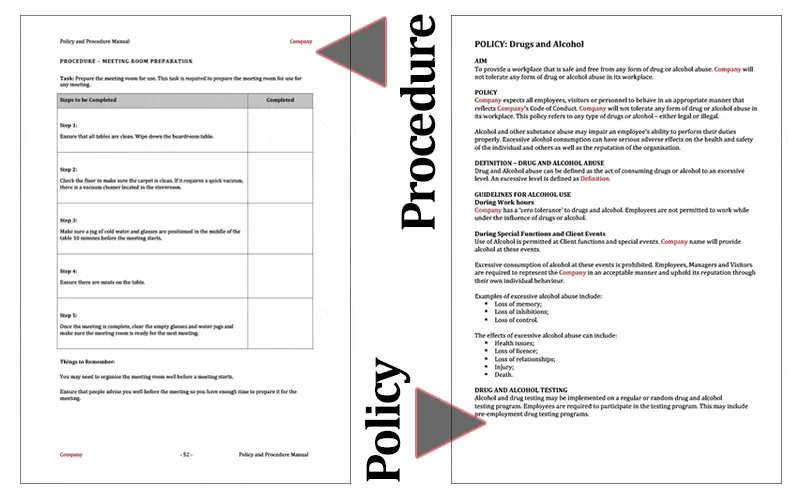
You can see from the graphic below as a simple business procedure example of the difference between a procedure and a policy.
Policy Manuals
Policies are usually descriptive and full of text. They outline the ‘rules’ and expectations.
Procedures Manuals
Procedures are usually step by step examples of how to complete a task. Part of a process.
✅ Best Practice
Tools for Communication. The two documents work in tandem, with Policy Manuals offering guidelines and Procedure Manuals explaining how those rules are put into action.
These are two different documents but have similar aims – to educate, teach and show your team what your expectations are as business operator.
Procedure Manual Template Video – Demo and Walk-through
Watch and learn with the Procedure Manual Template Video – Demo and Walk-through
Understanding Procedure Manuals in Depth
Key sections every Procedure Manual Should Have
A procedure manual should include the following key elements.
1.0 Introduction and Purpose
Begin with an introduction that explains the purpose and scope of the manual.
Provide an overview of why the manual exists and how it benefits the organization and its employees.
2.0 Table of Contents
Include a clear and organized table of contents that lists all the procedures and topics covered in the manual.
This makes it easy for users to find specific information quickly.

3.0 Procedures and Workflows
Detail the step-by-step procedures and workflows for key tasks and processes within the organization.
Ensure that each procedure is clearly written, concise, and easy to understand. Use headings, subheadings, and bullet points for clarity.
4.0 Responsibilities and Roles
Clearly define the roles and responsibilities of employees involved in each procedure.
This helps employees understand their specific duties and accountabilities within the organization.
5.0 Reference Materials
Provide any necessary reference materials, such as forms, templates, checklists, or external resources that may be needed to complete the procedures.
These materials should be easily accessible within the manual or as appendices.
These five points form the basic structure of a procedure manual, and you can expand upon them to create a more comprehensive and detailed document tailored to your specific business needs.
Mandatory HR Procedure Manual Content
Language and Tone for System Documents
The language and tone of a procedure manual should be clear, concise, and easily understandable for the target audience.
Generally the language and tone should:
- Clear and straightforward
- Maintain a consistent writing style and format
- Concise and to the point
- Use an ‘active voice’
- Have an organized structure
- Use visual aids and be user-focused.
The language and tone may vary based on the specific context and audience of the manual.
How to Create Your Own Procedure Manual with a Template
Combine Policies with Procedures
If you are a small business or just starting out, consider creating a combined Policy and Procedure Manual, as the two complement each other.
This will ensure efficiency, ease of use and operation.
💡 Tip
Structure for Success. The first thing you can do is separate your manual into 2 sections. Policies and Procedures.
Creating policies and procedures in your business improve your quality management system all around.
Below is a typical Policy and Procedure Manual format that you could use for your business.
Summary of sections for a Policy and Procedure Manual
Below are a list of typical headings you could have in a Policy and Procedure Manual.
- Introduction
- Purpose and Scope
- Roles and Responsibilities
- Policies
- Procedures
- Compliance and Legal Requirements
- Training and Implementation
- Monitoring and Review
- Appendices and References
If you need to develop an office procedure manual then you should consider purchasing a template.
This will save you significant time and effort. Generating a procedure manual from scratch is a huge task.
Start with a Table of Contents to Plan Your Procedure Manual
The best way to start your Procedure Manual is to draft the Table of Contents.
You can simply create your own or copy some of the sections from below.
Procedure Manuals, Policy Manuals and Employee Handbooks all have different purposes.
- Procedure Manual Purpose: Focuses on how tasks are performed in the business.
- Policy Manual Purpose: Focuses on the “why” and the rules.
- Employee Handbook Purpose: Focuses on rules, expectations, and culture of the workplace.
For a more comprehensive Procedure Manual, include extensive information and policies that apply to your business.
Example of a Policy and Procedure Manual Template Table of Contents
Introduction
1.1 Purpose of the Manual
1.2 Scope and Applicability
1.3 Revision History
Roles and Responsibilities
3.1 Job Descriptions
3.2 Role Clarity
3.3 Team Hierarchy
Procedures and Processes
4.1 Workflow Diagrams
4.2 Standard Operating Procedures (SOPs)
4.2.1 [Procedure Name 1]
4.2.1.1 Purpose
4.2.1.2 Scope
4.2.1.3 Responsibilities
4.2.1.4 Procedure Steps
4.2.1.5 References
4.2.1.6 Revision History
4.2.2 [Procedure Name 2]
(Repeat structure as above)
4.3 Work Instructions
4.4 Checklists
Policies and Guidelines
5.1 Company Policies
5.1.1 Code of Conduct
5.1.2 Health and Safety
5.1.3 Diversity and Inclusion
5.2 Legal Compliance
5.3 Data Protection and Privacy
5.4 Quality Standards
Training and Development
6.1 Training Programs
6.2 Skill Development Initiatives
6.3 Continuous Learning Opportunities
Documentation and Record Keeping
7.1 Document Control
7.2 Record Retention
7.3 Version Control
Communication Protocols
8.1 Internal Communication
8.2 External Communication
8.3 Crisis Communication
Monitoring and Evaluation
9.1 Key Performance Indicators (KPIs)
9.2 Performance Evaluation Processes
9.3 Process Improvement Strategies
Appendices
10.1 Glossary of Terms
10.2 Acronyms and Abbreviations
10.3 Forms and Templates
10.4 Additional Resources

How to create a Procedure Manual step by step
Don’t want to build your own? Save time and download our ready made procedure manual template.
Build a Procedure Manual Step by Step
Step 1: Define the manual’s purpose & scope
Decide what the manual will cover (e.g., “Front-of-house operations for small cafés” or “Project handover for architecture”). Spell out who it’s for and what it will not include.
Step 2: Identify key processes
Make a list of all repeatable activities that need standardizing (on-boarding, invoicing, equipment checks, client handovers, incident reporting, etc.). Rank them by business impact or frequency to decide what to write first.
Step 3: Choose a consistent structure (template) for procedures
Use a uniform format so users can quickly find info. Typical sections: Purpose, Scope, Roles, Materials/Tools, Step-by-step Procedure, Safety/Quality checks, Exceptions, Revision history.
Step 4: Write procedures step-by-step
Use clear, active language and short sentences. Number steps. Include who does each step and include screenshots or sample forms where it helps. Aim for “can be followed by someone who’s never done it”.
Step 5: Assign owners & approvals
For each procedure, name the owner responsible for accuracy and the approver (manager or subject-matter expert). Add a revision date and version number.
Step 6: Publish & train
Make the manual easily accessible (shared drive, intranet, printed binder). Deliver short training sessions or quick how-to videos for teams so the manual becomes the default way to work.
Step 7: Maintain & review regularly
Set a review cycle (e.g., annually or biannually) and a fast process for urgent updates. Keep a change log so everyone knows what changed and why.
Step by Step Individual Procedures
Step-by-Step procedures are the actual procedures to perform a task. You need these to go into your procedure manual to create the overall document.
Need to create the actual procedures? Step by Step Procedures help your team deliver their work accurately.
Need a Policy and Procedure Manual for Your Business?
If your business relies on people knowing what needs to be done and how it should be done, a Policy and Procedure Manual can give you a much better starting point than trying to document everything from scratch.
Our Policy and Procedure Manual Template gives you a ready-to-edit Microsoft Word document covering the key policies, procedures and processes businesses commonly need.
It includes a comprehensive Policy and Procedure Manual, together with 44 additional Word and Excel templates to help you document your business processes, responsibilities and day-to-day operations.
You can download the files instantly, customise them for your business and use the content as a practical starting point for creating your own policies and procedures.
Want to See the Full Template?
If you want to see exactly what you’re getting before you buy, visit our full Policy and Procedure Manual Template sales page. It includes the complete Table of Contents, examples from the actual template, details of all 44 additional templates, FAQs and everything included in the package.
Ready to get started? You can purchase the Policy and Procedure Manual Template directly below.